

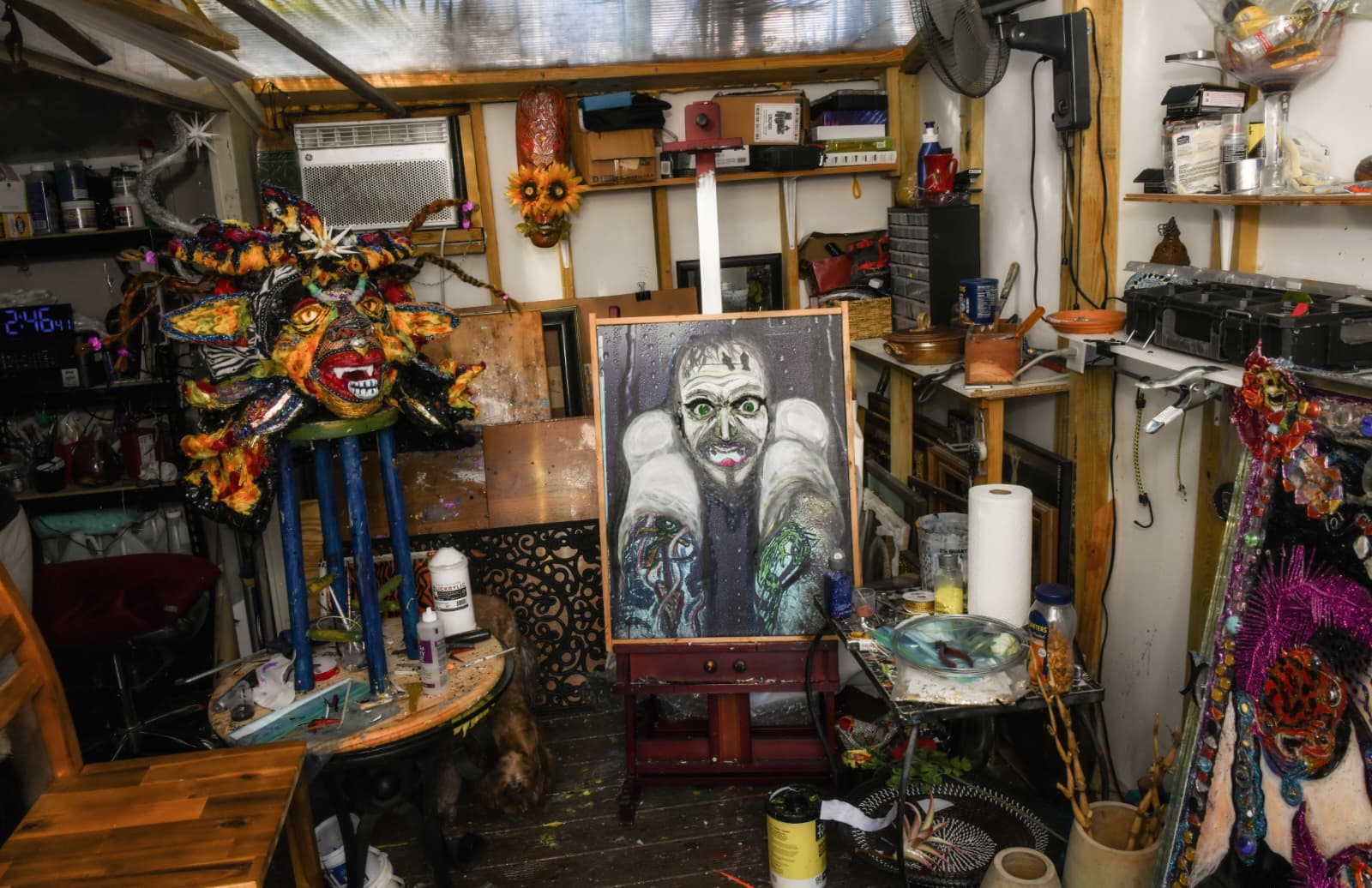
The Story of the Crooked Hooker
Some lives seem to follow a straight line. The Crooked Hooker’s never did.
The path twisted through sheet music, theatre lights, and painted scenery long before it ever settled inside a frame.
Origin
Before there was “The Crooked Hooker,” there was a child obsessed with images.
He cut up magazines he wasn’t supposed to touch, drew in the margins of books, and stared for hours at objects everyone else called trash. No one called it “art” back then. It was just “too much imagination.”
Later came music and theatre. He studied directing, acting, scenic design. He spent years between rehearsals, dressing rooms, and empty stages at midnight. He directed plays, designed sets, and built worlds that only existed as long as the lights were on.

From Stage to Studio
At some point, the magic of theatre started to feel like a cage. Too many voices in the same story. Too many compromises for someone who, deep down, wanted to build entire universes without asking permission.
The transition wasn’t a dramatic break; it was a quiet drift. Leftover set pieces saved “just in case.” Found objects picked up from the street. Photographs taken almost by reflex. Slowly, those loose fragments began to demand their own stage—not a theatre, but a box, a panel, an assemblage.
That’s where The Crooked Hooker was born:
when he decided the work no longer needed actors, curtains, or applause. Just a frame, a surface, and enough time to listen to what each object wanted to say.
The Visual Language
Today, The Crooked Hooker works as if still directing a play—but in absolute silence.
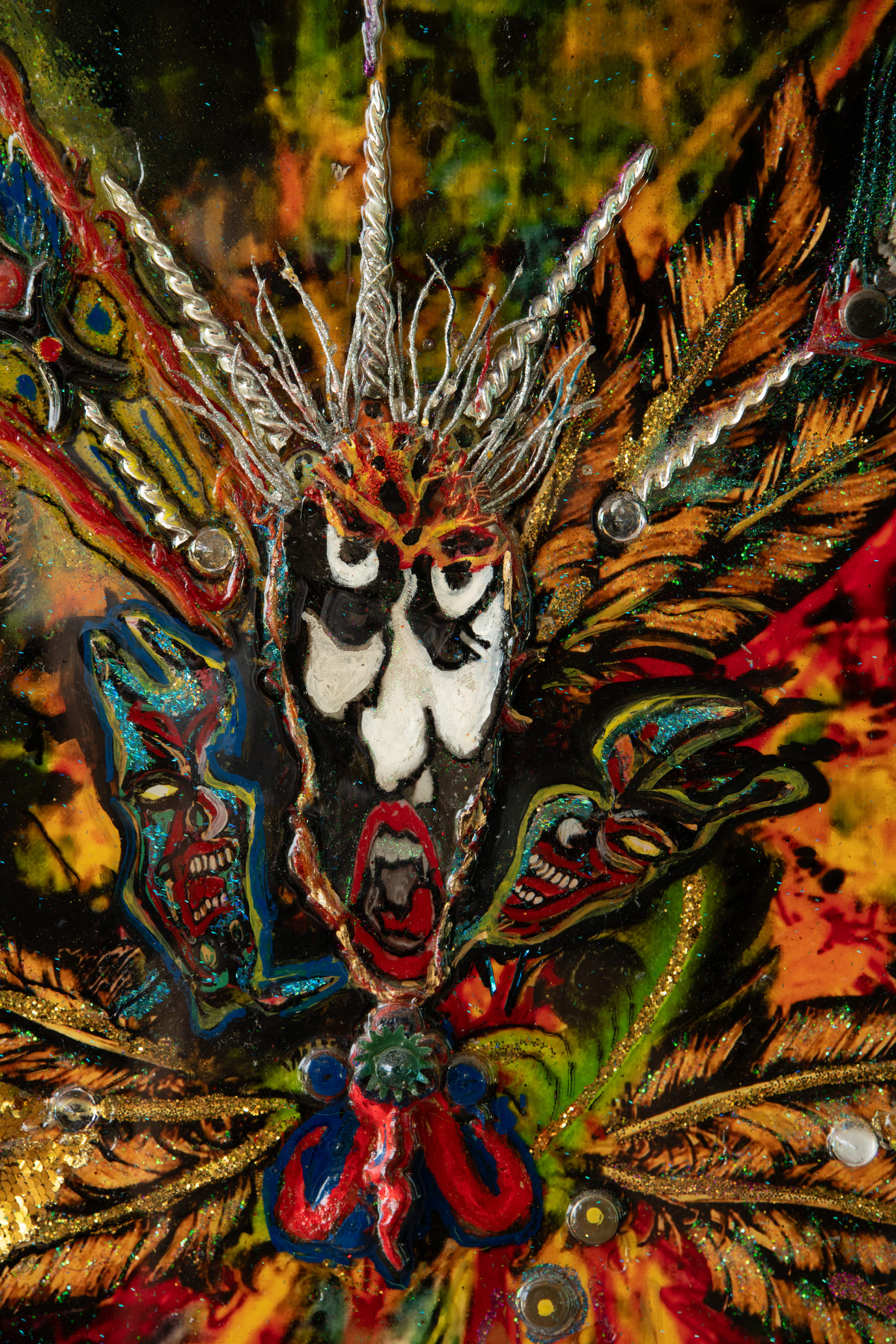
He sometimes begins with a photograph he has taken and altered, stretched until it becomes almost a map. Over it he draws, paints, tears, cuts, and reassembles. He adds bits of metal, small bones, stones, broken toys, religious fragments, personal symbols. Nothing enters the piece by accident.
When the composition finally “breathes” the way it should, he seals it under layers of resin. There’s no glass, no distance—just a glossy skin that fixes everything in place, like a moment pinned in time.
Each piece becomes a small crooked altar:
part relic, part confession, part cosmic joke.

The Crooked Manifesto
The Crooked Hooker isn’t interested in making comfortable images.
He’s after friction: between sacred and ridiculous, intimate and exposed, beautiful and disturbing.
The work starts from a simple, brutal idea:
everything we try to forget leaves remains.
Those remains—objects, memories, symbols—become raw material.
This project exists to give visible form to what usually stays in the dark. To remind us that life is rarely told in a straight line; it almost always unfolds, like his name, crooked.
And each Crooked Hooker piece is exactly that:
a crooked story that refused to be contained.
